
Slaves and Sanctuary: Expert blog

Dr. Jessica Clarke

Our Expert in Residence, Dr Jessica Clarke, shares some of her latest research in this member blog. These objects are discussed in further detail in her forthcoming book 
A New History of Ancient Roman Theatre, available for pre-order from Liverpool University Press.


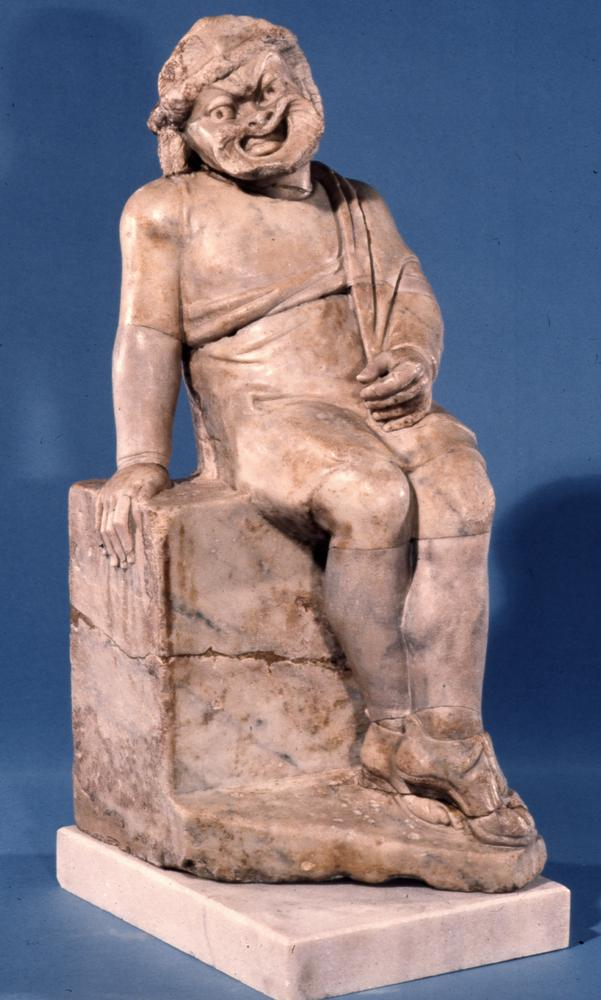
High on a shelf in the Vatican’s Museo Pio Clementino, largely overlooked by the crowds flowing through the Galleria dei Candelabri, sits a finely carved marble figure of a comic slave character. Perched just above eye level, this remarkable object (inv. 2661) receives little attention from passing visitors, and even less in current scholarship. Yet it offers a powerful and revealing glimpse into the entangled world of theatre, political hierarchies, and enslaved experiences in the ancient world.

The statue, carved from high-quality Carrara marble sourced from quarries in the Luna mountains, stands at approximately 115cm tall. It depicts a familiar figure from Roman comedy: a slave character mid-performance, seated atop a large square altar. His ankles are crossed, his posture appears casual, and his right hand reaches back to support himself. A wreathed mask sits on top of his head, with sharply defined eyes, an open mouth and a visible tongue. Beneath the mask, the sculptor has carefully rendered the actor’s face, and the lips are just visible through the open mouth of the mask.
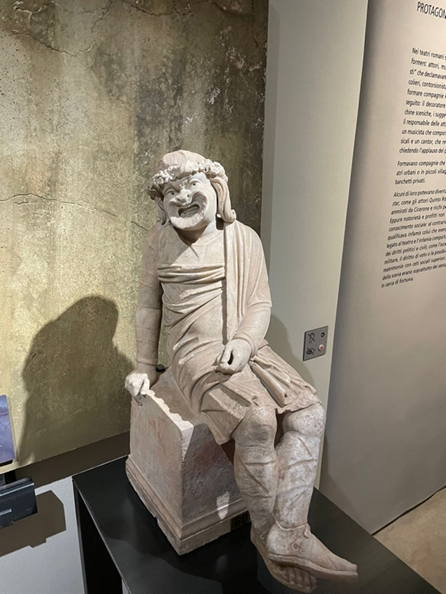
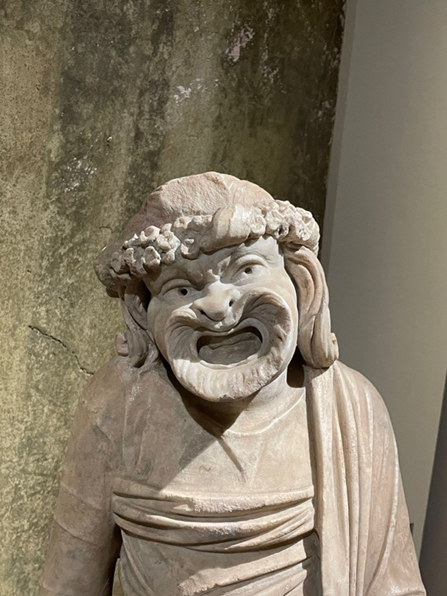
Photograph: J. Clarke

This finely executed sculpture dates to the early first century CE, a period when theatrical motifs were becoming increasingly popular in Roman domestic decoration. Yet the figure has a long iconographic history stretching back through the centuries.

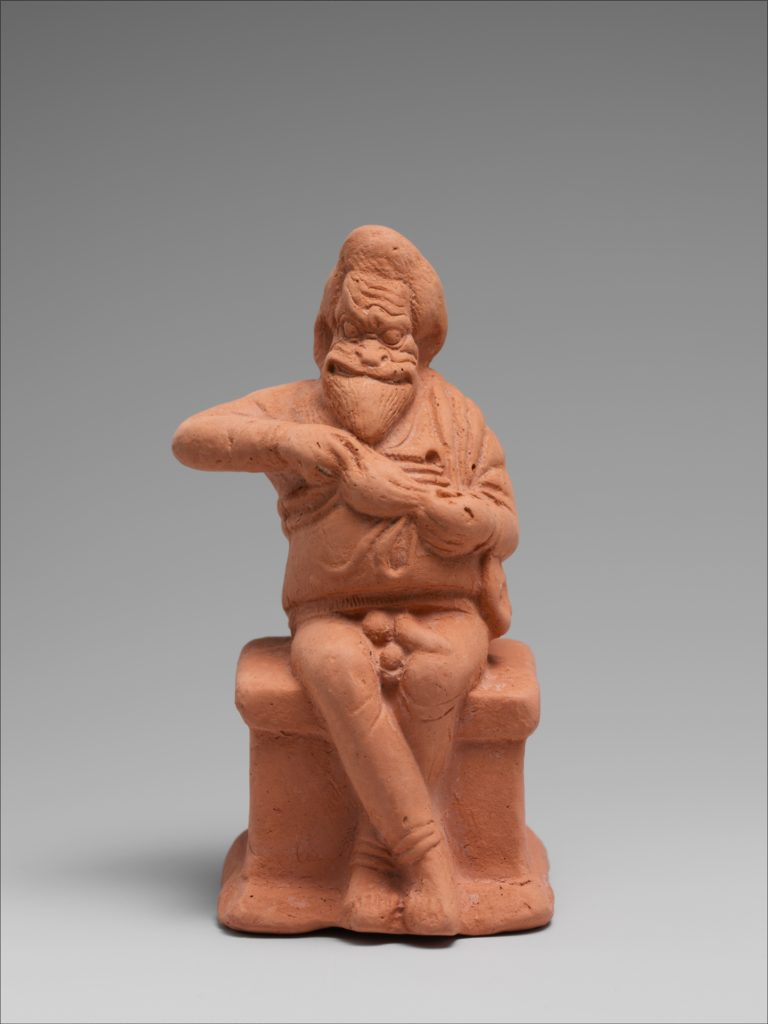
From the early fourth century BCE, small terracotta figurines of comic characters were deposited in Greek tombs, likely as markers of social status and cultural taste, or perhaps as tokens of protection for the deceased to take with them into the afterlife. Among these were figurines of slave characters, seated on square bases resembling altars. One such example, now in the Metropolitan Museum of Art (inv. 13.255.13-14 and 16-28), shows a masked figure wearing a traveller’s cap, his phallus exaggerated and clearly visible between his legs – a reference to the bawdy traditions of Old and Middle Comedy.

These figurines proliferated across the Hellenistic and Roman Mediterranean, and by the first century BCE, the medium had diversified. We have a striking bronze example which is currently housed in the British Museum (inv. 1878,0504.1). It presents a comic slave character sitting on an altar with his legs crossed, his chin resting on his right hand, and an exaggerated, gaping-mouthed mask. Though the findspot remains unconfirmed, the piece’s fine craftsmanship suggests that it was intended for domestic display, such as the decoration of a lararium (household shrine) or a niche in a well-appointed Roman home.
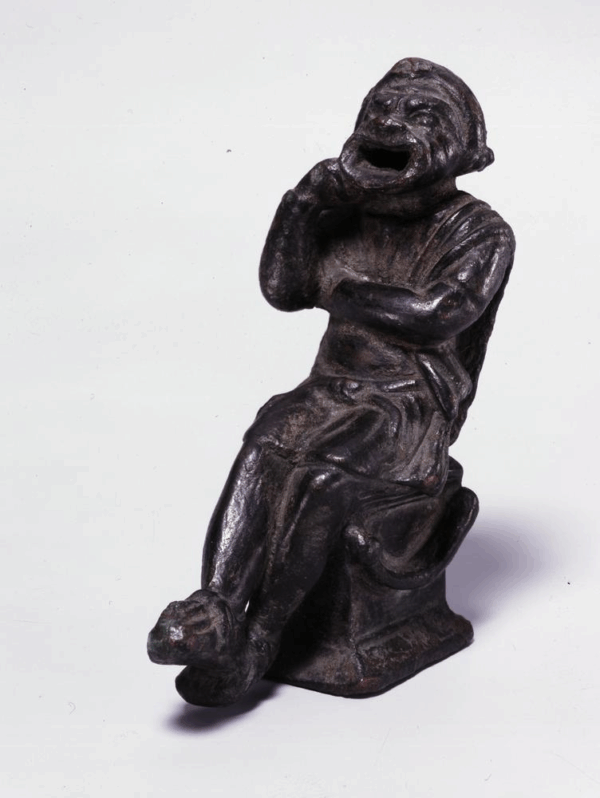
© The Trustees of the British Museum. Shared under a Creative Commons Attribution-NonCommercial-ShareAlike 4.0 International (CC BY-NC-SA 4.0) licence.

Indeed, the Vatican statue is not the only example that has been found rendered in marble. It has several siblings that are now scattered across the museums of Europe. One has been found in Albania, coming from the theatre at Byllis, whilst another, almost identical to the Vatican statue in size, material, and pose, is now in the British Museum (inv. 1805,0703.45). This British Museum version stands 60cm tall, with a base measuring 27cm by 32cm, and it was likely produced by the same workshop, perhaps even using the same template.
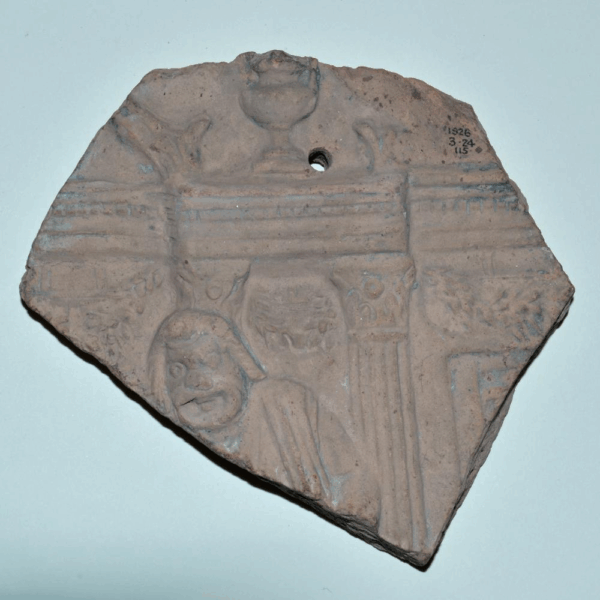
We can also see these scenes of seated comic slaves rendered on Roman frescos and terracotta relief panels. One example is a wall panel from Campania, which dates to the turn of the first century BCE, and is now housed in the British Museum (inv. 1926,0324.115). The fragment shows an actor wearing a slave mask in front of a scaenae frons. He has a mantle over his shoulder and leans towards his right. Using other panels that have survived and which display the same iconography, the entire scene can be reconstructed to show how the rest of the scene would have looked.

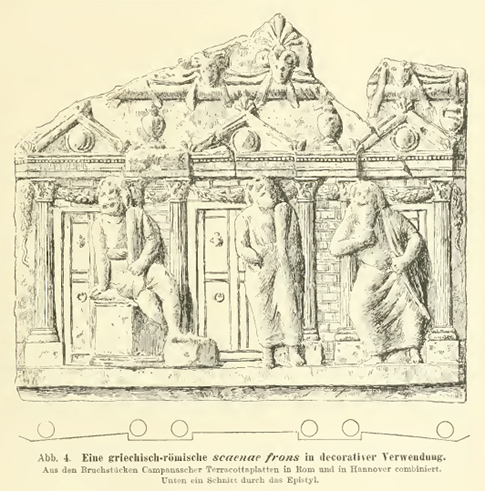
By piecing together various examples, the scene can be reconstructed as seen in the line drawing below, created by Otto Puchstein in the early twentieth century. We can see a slave character seeking refuge on an altar in front of a house, and an angry old man rushing towards him, whilst another male character (perhaps a younger man) stands between them, evidently trying to mediate the situation.
© The Trustees of the British Museum. Shared under a Creative Commons Attribution-NonCommercial-ShareAlike 4.0 International (CC BY-NC-SA 4.0) licence.
Abb. 4, Ein griechisch-Römische scaenae frons in decorativer Verwendung – illustration in Otto Puchstein’s Die Griechische Bühne: Eine Architektonische Untersuchung (page 27)

However, despite the quantity and excellent preservation of these images, this seated slave character has received remarkably little sustained scholarly attention. When mentioned in museum catalogues and or placed on display in exhibitions, they are often relegated to the status of minor decorative items and stripped of their interpretive depth and cultural context. The Vatican statue is even sometimes mislabelled in exhibitions, so that there is no acknowledgement that the character being depicted is a representation of an enslaved individual. As a result, the social commentary embedded in these objects and their potential to illuminate ancient attitudes towards slavery, social hierarchy, and humour remains largely unexplored.

So, what exactly do these statues depict? Why does this image of a seated comic slave on an altar appear across the centuries and in different media? What was its significance to Roman audiences? Particularly those wealthy enough to commission such pieces for their homes?

The answer lies in a recurring dramatic trope from Greek New Comedy and its later adaptations in the Latin palliata of the second century BCE. In examining these images, we are looking at representations of a slave character who seeks sanctuary by fleeing to an altar, where he should (in theory) be safe from all physical harm. A particularly vivid example survives in a fragmentary piece of papyrus of the play Perinthia by Menander (POxy 855), in which the slave character Daos escapes punishment from his master, Laches, by taking refuge on an altar. Laches, enraged, threatens to burn him off and orders his other slaves to gather wood for a bonfire. The papyrus then breaks off before the resolution of the conflict.

What the scene seems to grapple with is whether the comic slave character deserves the protection which he seeks. Should an enslaved individual – even if he is a character in a play – be granted religious sanctuary at an altar? Or is this a laughable idea?

The same question can be identified in second-century BCE comedy, most noticeably in Plautus’ play Mostellaria. In the fifth act, the slave Tranio returns home to overhear his master (Theopropides) instructing the other servants to hide in the doorway with chains so that Tranio can be captured. Tranio frustrates Theopropides’ attempts to capture him by sitting on the altar just outside the front door of the house, where he can avoid being questioned. Theopropides is unable to get his slave to move from the altar (lines 1065-1125).

The scholarly consensus is that this is a deliberately farcical interaction. By placing the scene within a comedy, it seems to make a mockery of the idea that a slave could seek refuge from his master’s legal authority over him. Whilst he might try and seek refuge from physical violence at an altar, this was, ultimately, a comic idea rather than one that should be taken seriously by the audience.

A similar idea can be found in Plautus’ Rudens in which two young women owned by the pimp Labrax seek refuge in the temple of Venus. In seeking their return, Labrax asks: ‘I shouldn’t be allowed to take my own slave girls away from the altar of Venus?’ to which Daemones replies: ‘You aren’t allowed to: there’s a law among us’ (lines 723-5). In this case, we can see that the comic scene is questioning what is permitted by the owner of a slave in relation to a religious sanctuary. Is Labrax permitted to forcibly remove his slaves, or are they safe when they are at the altar?

This brings us back to the statues. Why carve this specific moment – of ambiguous asylum and unresolved tension – into stone? Why was it some popular among the Roman elites? These statues offer an opportunity to confront how slavery was normalised, and perhaps also trivialised, through comic imagery, yet they have remained largely absent from the conversations that seek to interrogate these dynamics.

These images likely served as visual reminders of the ancient social order. If an enslaved person was disobedient, ran away, and evaded punishment, then they could be pursued by their master, even, perhaps, into places of sanctuary. This was an important message in the context of homes with numerous enslaved individuals. As current scholarship is in general agreement, slave labour was essential to the functioning of a large Roman home, and slaves were continually present in daily routines.

If we consider these statutes in the context of a household inhabited by enslaved people, the images seem to hold an overt and aggressive tone, perhaps reminding an enslaved person not to try and seek their freedom. Emancipation without consent was a laughable idea in its ancient context: a piece of fiction only appropriate for the comic stage.

© Jessica Clarke
Posted in Student Blogs

Nabataean Coins: A Royal Rebrand

Nabataean Coins: A Royal Rebrand

Our Expert in Residence, Hannah Parker (@historical_han), shares some of her latest research in a CA Member exclusive by exploring the shift in the way in which Nabataean kings appeared on coinage. This shift was instigated by King Aretas IV, who ruled from 9 BCE to 40CE, and his legacy continued until the Nabataean kingdom’s annexation in 106 CE.

The Nabataeans were the longest standing client kingdom in the Roman Near East. Client kingdoms were found across the Empire and were ruled by a rex socius et amicus populi Romani, which enabled Rome an effective method of control over its more distant provinces. As local rulers appointed by Rome, these kings served a dual purpose as both allies and political puppets. Their royal insignia was the Hellenistic diadem popularised by Alexander the Great and in turn their coin portraits typically depicted them in the guise of Hellenistic Kings. There were no exact guidelines for being a client king, with each ruler displaying various levels of ‘Romanophillia’ (a brilliant term coined by my supervisor, Dr Andreas Kropp), but many sent their sons to reside at the imperial court, creating opportunities for future leaders to network and to serve as insurance of their loyalty; some sent regular embassies, held festivals in honour of the Emperor and even depicted the Emperor on their coinage. The Nabataeans, however, sat at the opposite end of the spectrum – Aretas IV (9 BCE – 40 CE), defied convention and instigated a change in the face of Nabataean coinage that would last until the Kingdom was annexed by Trajan in 106 CE.

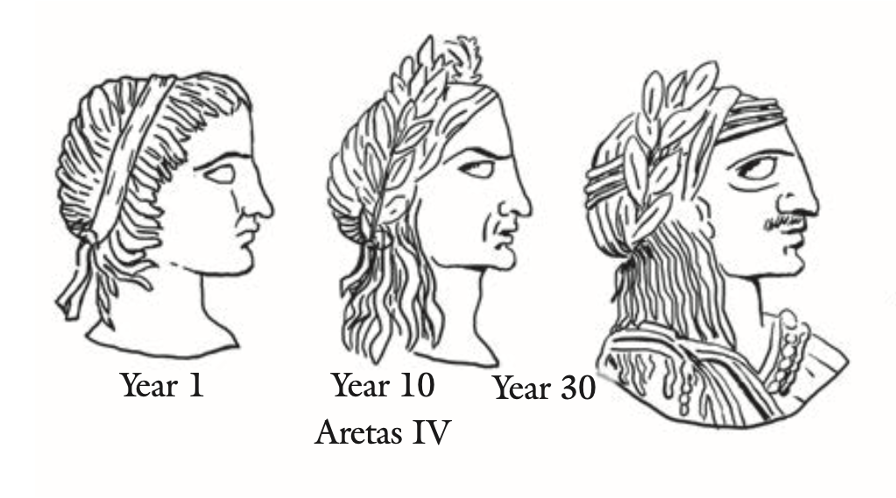
When his predecessor died, Aretas was appointed King without following the protocol of asking the permission of the Emperor. This initial blunder put a strain on the rulers’ relationship, and only after a series of complex negotiations was Aretas allowed to retain his new position. Likely to placate Augustus, his early coin issues followed custom, with the King slightly emulating the Emperor through a cropped Julio-Claudian hairstyle, albeit with a distinctly Nabataean style. This initial obedience however was short-lived. By the tenth year of his reign, Aretas had grown out his locks and swapped out his traditional diadem for a laurel wreath – the ultimate symbol of Roman imperator-ship. No other client king had dared to wear one. Though we have no sources to confirm it, this move can only be imagined to have caused further aggravation. 18 CE marked the debut of a new type of headwear, a different diadem that broke away from all prior convention. Alongside his controversial laurel wreath, the king wore a triple banded headband.

.Source: Kropp, A. (2013), Images and Monuments of Near Eastern Dynasts, 100 BC – AD 100 (Oxford), 23.

Although a precedent had already been set for stacked headwear during the Hellenistic age, this was a unique choice. Having no precedent in the Arabian peninsula, it was borrowed from the Kings of Parthia who had worn a ridged style diadem since the reign of Mithridates III (57-54 BCE). Parthian inspiration was not limited to headwear, with a simultaneous shift in costume. In place of a chlamys, Aretas was portrayed on coinage wearing a wide V-necked tunic borrowed from Parthian royal attire. The garment was decorated with ornate embroidery or pearls, represented by circular rowed patterns. Under their tunics, Parthian rulers wore trousers, a foreign concept to the Graeco-Roman world. Although no coin minted by the Nabataeans depict a trousered monarch, a Roman denarius struck in 58 BCE shows a trousered Aretas III.

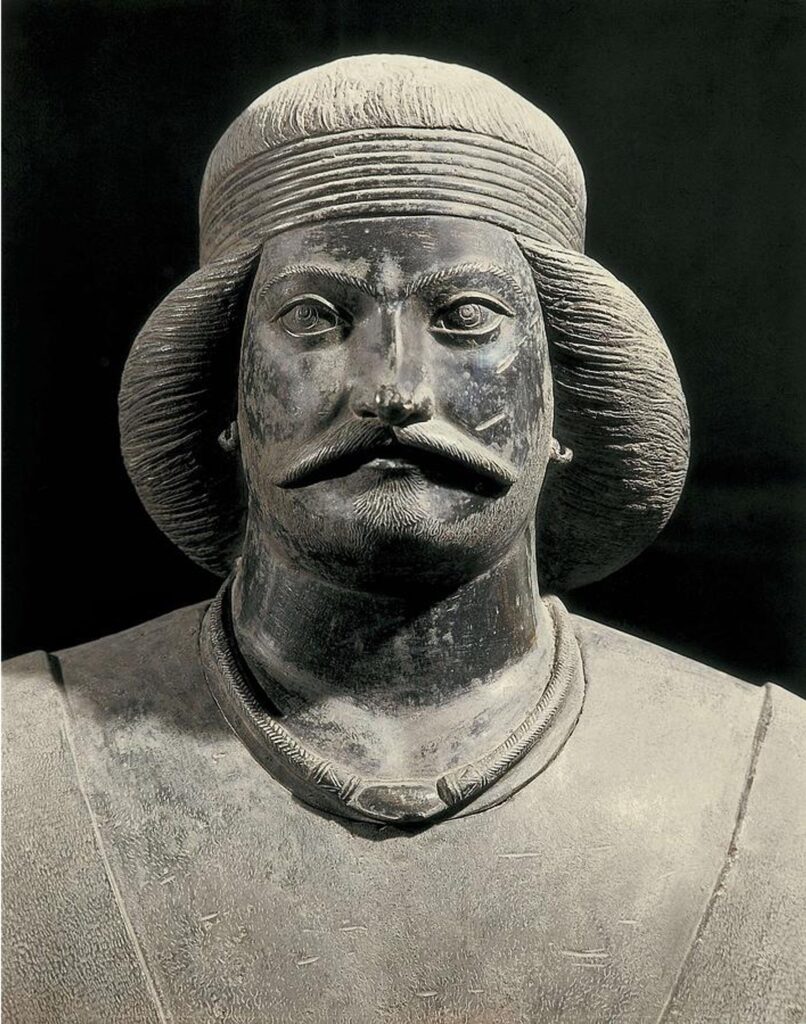
The everyday appearance of Aretas probably resembled the Shami statue (50 BCE –150 CE), with which his coin portraits bear striking similarities. The figure is long haired and has an almost clean-shaven face paired with moustache. These too were alien to the Romans but frequently found across the Near East. The statue illustrates a ridged diadem consisting of seven bands – a number that excels both those shown on Parthian or Nabataean coin portraits.

Bronze statue, circa 50 BCE- 150 CE, found at Shami. The man wears a Parthian diadem. From Wikimedia Commons (2023).

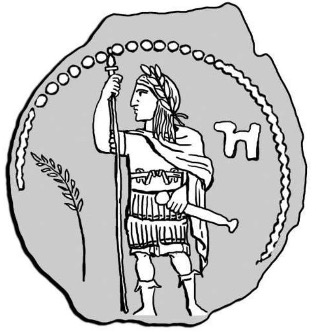
Only one account noting a Nabataean king’s appearance exists, recorded by Strabo quoting Athenodorus, who visited the royal court at Petra between 63 – early 20s BCE. The King wore similar clothes to the other men present; no tunics and “girdles about their loins”. In fact, the only symbols of status were purple slippers – a colour associated with royalty for over a millennia. The episode suggests that Aretas IV likely did not don headwear in his everyday life, perhaps showing its appearance on coinage functioned as a political message to outsiders rather than anything to do with how he was perceived by his own people. A full-length portrait of Aretas wearing cuirass and holding a spear was struck in circa 16 CE. Showing him in the guise of a Hellenistic king, it has been overlooked by scholarship. Its similarities with a relief from Dura Europos depicting Seleucus I Nicator in similar military dress are marked. Interestingly, the coin appears to be a special issue, perhaps minted in commemoration of his wedding with his second wife Shuqaylah. Therefore, Aretas IV probably never wore this outfit save for possibly special occasions.

A drawing of a bronze coin of Aretas VI, showing Aretas in military cuirass with a spear (circa 16 CE), by Andreas Kropp. Source: Kropp, A.(2013), “Kings in Cuirass – Some Overlooked Full-Length Portraits of Herodian and Nabataean Dynasts”, Levant, 45 (1), 49.

The most transformative element of Aretas’ portraits is his hairstyle, which I believe reflects him embracing his real image. Perhaps the short hair initially shown never existed at all, and it was a political tool to appease Rome. Then, once comfortable and established in his position, he felt able to reject convention, wearing his hair as he typically would, in a style established on the earlier coinage of Northern Arabia.

Considering the target audience of the material assists us in determining the motives behind the rebrand. Locally produced coinage would not have been legal tender outside of Nabataean territory so the primary intended consumer of the new image must be understood as the Nabataean people themselves. The King appears to have had a good relationship with his subjects, with the epithet “who loves his people” present on coinage. This reflects his priorities, where instead of being a friend to the Roman people, his loyalties lie with his community. Almost all Nabataean coinage rejects the conventional use of Greek or Latin. Rather, they used their dialect of Aramaic and their system of dating that denoted the year of the King’s reign. This retention of their own language indicates a clear desire to preserve their cultural identity, even long after Aramaic stopped being spoken in the everyday lives of Nabataeans, and this can be compared to civic coinage at Tyre.

The incentive to rebrand himself was a clear sign to Aretas’ people that his reign marked a new age for the Nabataeans. The shift in appearance was never an implicit rejection of Hellenism, but rather a refusal by Aretas IV to play the role of a Hellenistic king forced upon him by Rome. He quite literally removed the costume of the character he was being groomed to portray, and instead forged his own path and royal identity. Beginning with his bold move away from the Hellenistic diadem, Nabataean headwear set their wearers apart from the other client kings of the Roman Near East. By modelling himself on both the royal image of the Parthians and the Imperial image of Rome, Aretas IV established himself as their equal, with the insignias firmly understood by all players. Therefore, by choosing his own new cross-cultural royal emblem, Aretas IV rebranded himself, and his dynasty, as a different kind of Roman client king.

Posted in Student Blogs

Sardis – A Classical Wonder

Sardis – A Classical Wonder

In our latest blog, Year 12 student Altan Mardin, who has a keen interest in archaeology, tells us all about his recent trip to Sardis.

Drone photography of Sardis. Credit: The Archaeological Exploration of Sardis

Atop the Acropolis, looking out at the expansive city before me, it was almost impossible not to picture the attacking Persians – Cyrus’ fierce hordes looming before the doomed Sardis. Sardis, the capital of the ancient kingdom of Lydia and the birthplace of coinage, was an immensely rich city both in wealth and history, populated by successive arrivals since the Bronze Age of many diverse peoples. As they settled there, they often recycled the building materials of the previous settlement, allowing for the rich backdrop that makes Sardis so alluring to archaeologists eager to analyse the inflections of many overlain civilisations.

During my time at Sardis, I felt as if I was physically living the myths that I’d learned about in lessons. It was truly breathtaking to see drone footage of the very fortress that Croesus retreated to during the Persian invasion, and I even saw Mount Tmolus itself, who in classical mythology is said to have judged a musical contest between Pan and Apollo.

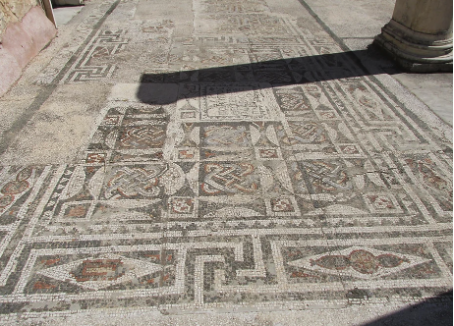
My time there was simply unforgettable, and unquestionably the most memorable site was the synagogue, which takes up a corner of the Roman bath-gymnasium complex. As we entered, a kaleidoscopic carpet of immaculately preserved mosaics greeted us. Deft patterns and blends of colour mazed around the floor, while panels in one corner depicting popular optical illusions introduced a playful complexity.

The stunning mosaics are sheltered by an expansive protective roof, recently built to solve the urgent need for an innovative method of preventing irreparable weather-induced damage. While we were there, many members of the archaeological team were busy replacing lost segments of mosaics with arrays of new, locally produced tesserae –  a delicate and absorbing craft we could have watched for hours, and only one example of highly skilled anastylosis being practised by the Excavation team throughout the site.

Mosaics on the floor of the synagogue. Credit: www.thebyzantinelegacy.com

The whole team at the Sardis compound is deeply knowledgeable, warm, and energetic. Everyone I met was extremely welcoming, and keen to share the fascinating discoveries at the site.  A tremendous amount of historical objects has been unearthed and delicately restored, from a time-period spanning all the way from the Bronze Age to the Byzantine, and at an amazing pace thanks to the innovative use of new methods and technologies, such as photogrammetry and 3D printing.

Mealtimes were a treat – we’d all meet at a huge table to enjoy regional Turkish dishes and chat about recent local findings, and their context and meaning.

For any other students eager to get involved, I’d suggest first trying to determine specific areas of interest. For instance, on a visit to the British Museum a few years ago, I vividly remember being struck by the incredible precision and life-like qualities of the classical sculptures – thereafter I became very interested in the site of Aphrodisias, once home to renowned schools of sculpture, and still boasting many splendid marble pieces. I was fortunate enough to visit a few years later.

Archaeological sites tend to be friendly and accessible – in my experience, the team at Sardis was most open to sharing their knowledge and allowing others to enrich their appreciation of Classics. Sardis harbours innumerable fond memories for me, and I hope to return soon to again experience all it has to offer.

More information can be found at the links below:

The Sardis Expedition website

The story of Croesus

Sardis in late Antiquity

Dating of the Synagogue of Sardis

Posted in Student Blogs